Cracked teeth: how they happen and how they’re treated
A cracked tooth can be surprisingly hard to pin down - the discomfort comes and goes, and the crack itself is often invisible to the naked eye. Under the dental operating microscope I can find cracks early, work out how deep they run, and plan the right treatment to give the tooth its best chance of staying in function.
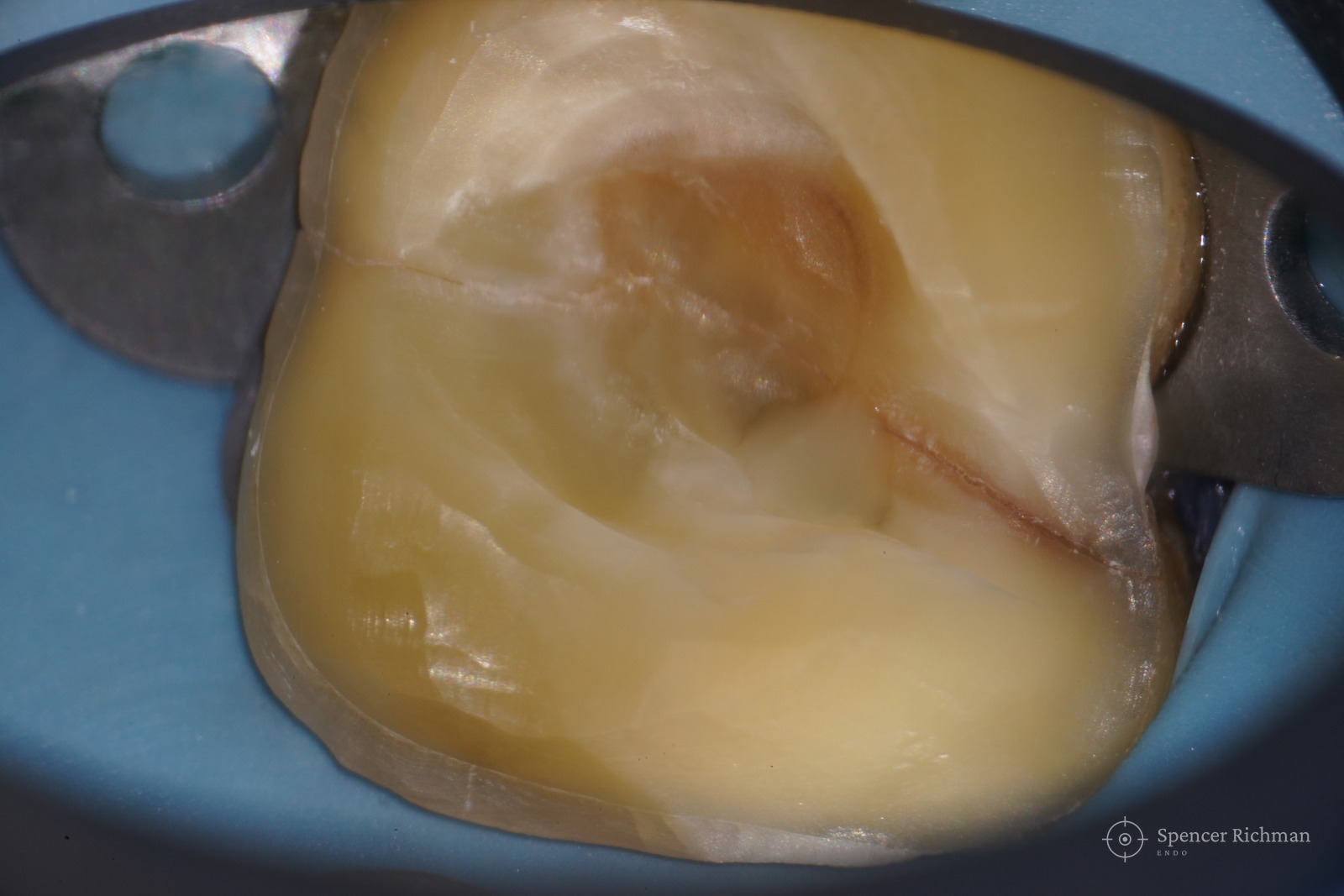
A cracked molar under the dental operating microscope - the fracture line runs right across the biting surface.
What is a cracked tooth?
A crack is a line of damage running through the hard structure of a tooth. Some are tiny lines in the surface enamel that never cause trouble; others run deeper, into the dentine or towards the nerve, and these are the ones that cause symptoms and need treating. Because a crack can open slightly under pressure and close again, the crack may be there for months or years before being picked up - which is exactly why the discomfort tends to come and go.
The different types of cracked teeth
Not all cracks are the same, and the type matters - some need nothing at all, while others decide whether a tooth can be kept. These are the main kinds, from least to most serious.
Craze lines - tiny cracks in the outer enamel only. They’re very common, especially as we get older, and are usually harmless - no treatment is needed.
Fractured cusp - a piece of the biting surface, often around an old filling, weakens and breaks away. This is usually only mildly uncomfortable, and the tooth can generally be rebuilt - sometimes with a filling, more often with an onlay or crown - usually without needing root canal treatment.
Cracked tooth (cracked tooth syndrome) - a crack that runs from the biting surface down towards the root. That pattern is the classic cause of pain that comes and goes when you bite down on something, often smaller or harder foods, and then release. Caught early, a crown or onlay can usually protect and save the tooth; sometimes root canal treatment is needed first.
Split tooth - what can happen when a cracked tooth is left too long: the tooth eventually splits into separate segments. Sometimes one part can be kept, but sometimes the tooth, or part of the tooth, can no longer be saved and has to be removed. Where the tooth can be saved, root canal treatment and an onlay or crown are usually needed. This is exactly why acting early matters.
Vertical root fracture - a crack that either begins in the root itself or spreads down into the root from the tooth above. These fractures often cause few, vague symptoms and tend to be found late, so the tooth usually cannot be saved. A CBCT scan and the dental operating microscope help diagnose a vertical root fracture and plan what happens next - usually, the tooth needs to be removed.
Why teeth crack
Teeth crack for a few main reasons. The most common is everyday biting force - years of heavy chewing, and especially grinding or clenching (often overnight), place enormous repeated load on a tooth. A sudden injury or knock can crack a tooth outright. And teeth that already carry large fillings are more vulnerable, because less natural tooth remains to absorb the load - this is especially true of older amalgam (silver) fillings, which don’t bond to the tooth and can act like a wedge over many years.
Signs you might have a crack
The classic sign is a sharp pain when you bite down or, tellingly, when you release the bite. You might notice sensitivity to cold or sweet things, or an ache you can’t quite place to a single tooth. Symptoms often come and go, which can make a crack frustrating to track down - but that on-and-off pattern is itself a useful clue that points towards a crack.
What does a cracked tooth feel like?
Pain from a cracked tooth is often sharp and sudden rather than a constant ache. Many people notice the pain when biting on something firm, or the moment they release the bite, as the crack opens and closes. The pain can come and go for weeks, and is often hard to pin to one tooth. Cold drinks or sweet foods may cause a brief, sharp twinge. If a crack is left untreated, bacteria can reach the pulp (nerve) and pulpitis can develop.
Finding the crack
Cracks are often invisible to the naked eye, so I examine the tooth under the dental operating microscope, where fine lines stand out under strong, magnified light. Shining light through the tooth, and where helpful a dye that seeps into the crack, can reveal its path. Sometimes the clearest picture only appears once an old filling is removed and the crack can be traced across the tooth.

Under the dental operating microscope, once an old filling is removed, the crack can be traced across the tooth.
How a cracked tooth is treated
Treatment depends on how deep the crack runs. Caught early, a crack can often be managed by removing the weakened, cracked structure and rebuilding the tooth so that biting force is taken off the crack. If the crack has reached the nerve and caused lasting damage, root canal treatment may be needed to settle and keep the tooth. Occasionally a crack runs too far - down into the root - and the tooth can’t be saved; finding that out early, and honestly, matters just as much. Where grinding or clenching is part of the picture, a well-made nightguard helps protect the tooth going forward.
A cracked molar restored under the dental operating microscope - the crack, isolating and building the tooth back up, and the finished result.
Working together to restore your tooth
Saving a cracked tooth is often a two-part job. There’s the endodontic side - assessing how far the crack runs and, where the nerve is involved, carrying out root canal treatment to settle the tooth - and the restorative side, rebuilding the tooth to take full biting force again, usually with a cusp-covering onlay or crown that holds the tooth together and stops the crack spreading.
I work closely alongside expert restorative dentists, so both sides are planned and carried out as one joined-up treatment rather than a series of disconnected appointments. You’re looked after by a team that’s already talking to each other, with a single shared goal: getting your own natural tooth back to comfortable, lasting function.
At Bellevue, Sardinia House and Widegate House, we also have the technology to design and fit a crown in a single day. The tooth is scanned digitally and the crown made and placed in the same visit, so there’s no temporary crown, no second appointment and no weeks of waiting between stages - you leave with the tooth fully restored, protected and back in normal function.
A cracked upper molar in a patient who grinds, seen at short notice and rebuilt with an all-ceramic crown in a single visit.
An upper molar cracked in a patient of thirty with almost no fillings, where years of grinding had done the damage instead.
Common questions about cracked teeth
Can a cracked tooth be repaired?
Often, yes - especially when the crack is caught early. Whether a tooth can be kept depends on how far the crack runs: many cracked teeth can be protected and saved, while a crack that reaches deep into the root may mean the tooth cannot be. Assessing the tooth under the dental operating microscope is the way to know for sure.
Does a cracked tooth need to be extracted?
Many cracked teeth can be kept. Extraction may be needed when a crack has split the tooth into separate pieces, or runs deep down the root, as in a vertical root fracture. A CBCT scan and examination under the dental operating microscope help to show how far a crack extends before any decision is made.
Can a cracked tooth heal on its own?
No. Unlike bone, enamel and dentine cannot repair a crack. A crack can stay stable for some time, but it tends to deepen with chewing forces, which is why early assessment matters.
Is a craze line the same as a crack?
Craze lines are very fine lines in the outer enamel and are common in adult teeth. They do not cause pain and do not need treatment. A crack goes deeper, into the dentine, and can cause pain on biting.
Is a cracked tooth a dental emergency?
Not usually an emergency, but it is worth getting checked promptly, because cracks tend to spread over time. Sudden severe pain, swelling, or a piece of the tooth breaking away should be seen quickly.
Will a cracked tooth need a crown?
Frequently, yes. A cusp-covering onlay or crown holds the tooth together and takes biting force off the crack, which is often what keeps the tooth. At Bellevue, Sardinia House and Widegate House this can be done in a single day.
What happens if I leave a cracked tooth untreated?
The crack can deepen, the tooth can become painful or infected, and the crack may progress to a split that can no longer be saved. Treating the crack early gives the tooth its best chance.
How much does treating a cracked tooth cost?
It depends on what the tooth needs - a protective restoration on its own, or root canal treatment plus a crown. I will always assess the tooth first and give you a clear idea of the options and the cost before anything goes ahead. Read more about what affects the cost of root canal treatment.