CBCT scans in endodontics: seeing your tooth in 3D
Some teeth give up their secrets easily; others need a closer look. A CBCT scan gives me a detailed three-dimensional view of your tooth, so treatment is planned around exactly what’s there - not a best guess from a flat X-ray.
What is a CBCT scan?
A cone beam CT scan is a 3D X-ray. Where an ordinary dental X-ray is flat and in 2D, a CBCT builds a three-dimensional picture of your tooth, its roots and the surrounding bone, which we can look through together slice by slice.
Why a 3D view helps
Roots are narrow, curved and often hide extra canals. Seeing those roots in three dimensions helps me find canals a flat image can miss, judge the extent of any infection, and spot cracks or unusual anatomy before we begin.
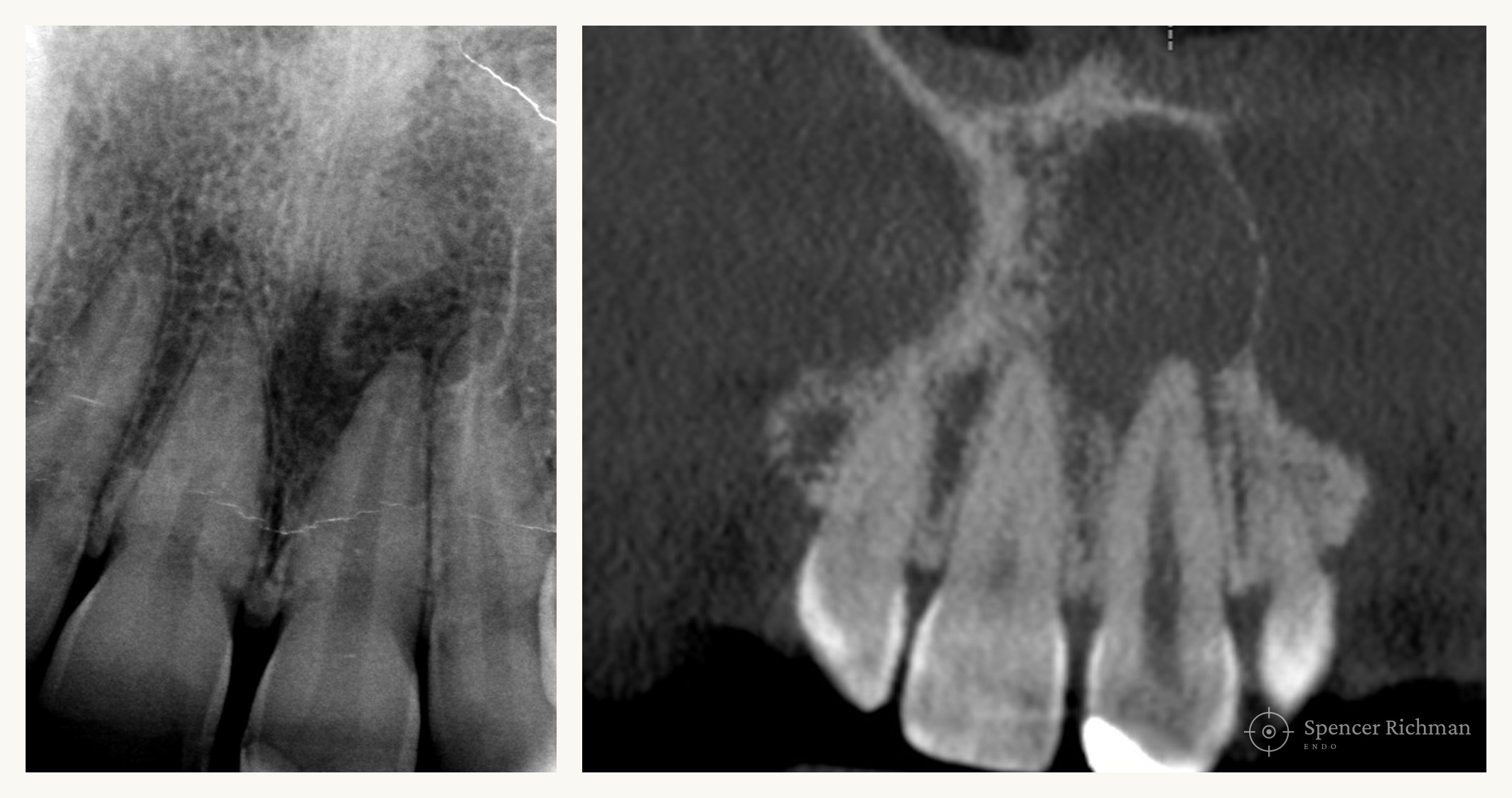
Especially useful for difficult cases
For re-treatments, calcified or hard-to-find canals, and teeth that haven’t settled after previous treatment, a 3D scan often makes the difference between a confident plan and guesswork.
Is a CBCT scan safe?
A CBCT uses a low dose of radiation, focused on the small area of interest, and I only take one when the information the scan gives will genuinely improve your treatment. The benefit to your care is always weighed against that small exposure, in line with current guidelines.
What a CBCT scan is like
The scan is quick and entirely comfortable. You simply stay still for a few seconds while the scanner moves around your head - no injection, and nothing touching the tooth.
The difference a 3D scan makes
Not every tooth needs a 3D scan, but when a scan helps, the extra detail lets me treat with far more certainty and preserve as much of your natural tooth as possible.
A cracked lower second molar where a CBCT scan confirmed external inflammatory resorption, and that finding shaped what was possible.